Imari Porcelain: A Guide to Japanese Porcelain
October 29, 2026
At Patrick Moorhead Antiques, we have a particular appreciation for decorative objects with a strong sense of history, colour and character. Japanese porcelain offers all three in abundance. From richly decorated Imari vases to finely painted dishes and striking ornamental pieces, antique Japanese porcelain has long been admired for its distinctive decoration and its place within the history of collecting.
Among the best-known styles is Imari porcelain, recognised for its combination of iron red, cobalt blue and gold. These striking colours, together with intricate patterns inspired by flowers, foliage, landscapes and traditional Japanese designs, have made Imari a favourite amongst collectors for generations.
But Imari is just one part of a much wider tradition. Japanese porcelain encompasses a remarkable variety of styles, each reflecting different artistic influences, decorative techniques and periods of production. Understanding a little of this history makes collecting Japanese porcelain all the more rewarding.
The Origins of Japanese Porcelain
Porcelain production in Japan began in the early seventeenth century, centred around Arita in what is now Saga Prefecture on the island of Kyushu. The development of these kilns marked an important moment in Japanese ceramics, establishing a tradition that would soon attract attention far beyond Japan.
The nearby port of Imari became an important point of distribution, and porcelain shipped from the region came to be known in Europe as Imari ware.
During the seventeenth century, Japanese porcelain began to reach European markets through international trade, including exports carried by the Dutch East India Company. Its arrival introduced European collectors to a distinctive approach to decoration, with finely painted designs, rich colours and carefully finished porcelain bodies.
Japanese porcelain quickly became a prized possession amongst wealthy collectors and aristocratic households. It was displayed in palaces and great houses, where decorative ceramics formed an important part of elaborate interiors and growing collections of Asian art.
Today, antique Japanese porcelain remains an appealing field for collectors, offering an extraordinary range of forms and decoration, from elegant blue-and-white wares to elaborate Imari pieces.
What Is Imari Porcelain?
Imari porcelain takes its name from the Japanese port through which much of the region's porcelain was shipped. Although the term is now closely associated with a particular decorative style, it originally referred more broadly to porcelain exported from the Arita area.
Traditional Imari decoration is particularly recognisable for its use of cobalt blue, iron red and gilding. These colours are often arranged across intricate patterns, combining floral motifs, scrolling foliage, geometric borders and other decorative elements.
Some examples feature bold, densely patterned surfaces, while others have more restrained compositions in which the decoration is carefully balanced against areas of white porcelain.
The variety is part of the appeal. A large antique Imari vase can make a dramatic focal point, while a pair of smaller porcelain vases or a finely decorated dish can introduce colour and pattern without overwhelming a room.
Imari was also produced in a variety of forms, including bowls, chargers, plates, jars and lidded vases. Many were intended for export, with designs that appealed to European tastes for richly decorated decorative objects.
The style proved so popular that Chinese and European manufacturers also produced their own interpretations of Imari decoration. As a result, when collecting pieces described as Imari, it is important to consider the country of manufacture, date, decoration and overall form rather than relying on the pattern alone.
Imari Vases and Decorative Garnitures
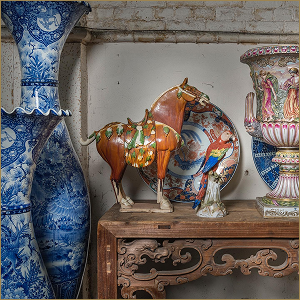
Among the most striking examples of Japanese porcelain are Imari vases. Their decorative impact comes from the combination of sculptural form and richly coloured surfaces, making them particularly effective when displayed as part of an interior.
Antique Japanese vases were collected in Europe not only for their craftsmanship and decoration but also for their ability to transform a room. Larger examples could be displayed on mantelpieces, cabinets or purpose-made stands, while pairs of vases offered a sense of symmetry and visual balance.
A garniture, usually consisting of a group of coordinating vases, could create an especially impressive display. Arranged along a mantelpiece or above a console, a collection of related pieces introduces rhythm and repetition while allowing each individual vase to contribute its own decorative detail.
When selecting an antique Imari vase, it is worth looking closely at the shape, the quality of the painted decoration and the relationship between the different colours. The most appealing examples often combine a strong silhouette with intricate detail, allowing them to be appreciated from across a room as well as at close quarters.
For those furnishing a home, Imari porcelain offers a particularly versatile way to introduce colour into an interior. Its combination of blue, red and gold works well alongside dark woods, painted furniture, mirrors and other decorative antiques.
Blue-and-White Japanese Porcelain
Although Imari is famous for its colourful decoration, blue-and-white Japanese porcelain is equally important within the history of Japanese ceramics.
These pieces typically feature cobalt-blue decoration against a white porcelain ground. The designs can include landscapes, flowers, birds, foliage and more abstract decorative patterns, with considerable variation in the density and style of the painting.
Some examples have an informal, expressive quality, while others feature carefully arranged compositions and repeating borders. This diversity makes blue-and-white porcelain an appealing choice for collectors who prefer a more restrained palette.
A blue-and-white Japanese porcelain vase can sit comfortably alongside both traditional and contemporary furniture. Equally, a collection of dishes or bowls can be displayed within a cabinet, arranged on open shelving or combined with books, paintings and other decorative objects.
The contrast between blue and white also makes these pieces particularly easy to combine with other forms of antique porcelain. Displaying blue-and-white wares alongside Imari creates an interesting dialogue between two different approaches to colour and decoration, while retaining a shared Japanese heritage.
Japanese Porcelain and European Decorative Arts
The popularity of Japanese porcelain had a lasting influence on European decorative arts.
During the seventeenth and eighteenth centuries, Asian porcelain became highly desirable amongst European collectors. Its decorative richness and technical qualities inspired European manufacturers, who began developing their own porcelain traditions and adapting elements of Asian design.
Imari was particularly influential. Its distinctive palette and elaborate patterns were copied by manufacturers in China and Europe, including several of the great European porcelain factories.
The relationship between Japanese porcelain and European design is especially interesting when considered alongside the history of Meissen. The fascination with Asian porcelain helped create the conditions in which European porcelain manufacture developed, and Japanese decorative styles continued to influence European makers long after their own factories were established.
For collectors, this shared history makes Japanese porcelain particularly rewarding to display alongside European ceramics, antique furniture and other decorative arts. A Japanese Imari vase placed on an English walnut cabinet, for example, brings together different traditions in a way that feels both historically informed and visually engaging.
At Patrick Moorhead Antiques, we appreciate how these contrasts can give an interior depth and individuality. The most interesting collections are often those that bring together objects from different periods and places, allowing their differences to become part of the overall composition.
How to Collect Antique Japanese Porcelain
Collecting Japanese porcelain can begin with a particular style, colour or type of object, but there is no single approach. Some collectors concentrate on early Imari, while others are drawn to blue-and-white porcelain, decorative vases or pieces that complement an existing collection of furniture and objets d'art.
When considering antique Japanese porcelain, several factors are worth taking into account.
Date and origin
Japanese porcelain developed across different periods and production centres, and the date and origin of an object can have an important bearing on its interest and desirability. Imari is a useful starting point, but the term alone does not establish a precise date or place of manufacture.
Decoration and quality
Look closely at the painted decoration, the use of colour and the overall balance of the design. The quality of the painting and the way the decoration follows the form of the vessel can be particularly revealing.
Form and scale
Consider how the piece will be displayed. A large vase may work as a standalone focal point, while smaller objects can be grouped together or incorporated into a wider collection. Pairs and garnitures can be especially effective when a sense of symmetry is desired.
Condition
As with any antique ceramic, condition should be assessed carefully. Look for chips, cracks, restoration and areas of wear, paying particular attention to rims, handles, feet and lids. The importance of any condition issue will depend on the individual object, its age, rarity and overall quality.
Marks and attribution
Marks can offer useful information, but they should be considered alongside the form, decoration, materials and other evidence. Not every Japanese porcelain piece is marked, and a mark alone may not provide a definitive identification.
For anyone building a collection, advice from a specialist antiques dealer can help clarify the characteristics of individual pieces and provide a better understanding of their place within the wider history of Japanese porcelain.
Displaying Imari and Japanese Porcelain at Home
One of the great pleasures of collecting Japanese porcelain is the opportunity to use it as part of a wider decorative scheme.
A pair of Imari vases can bring colour and symmetry to a mantelpiece or console, while a larger vase can provide a striking focal point on an antique cabinet. Smaller pieces can be grouped within a glazed bookcase or displayed alongside sculpture, paintings and other decorative objects.
For a more layered arrangement, consider combining different styles of Japanese porcelain rather than displaying everything as a matching set. The vivid colours of Imari can sit beautifully beside the quieter tones of blue-and-white porcelain, creating contrast without losing a sense of cohesion.
Japanese porcelain also works particularly well alongside antique furniture. The richness of a walnut or mahogany surface can complement the blue, red and gold of Imari decoration, while a painted cabinet can provide an interesting contrast to the white porcelain ground.
There is no need to restrict these pieces to formal rooms. A carefully chosen vase can introduce history and character to a contemporary interior, while a collection of smaller objects can add detail to a study, drawing room or entrance hall.
The key is to choose pieces that appeal to you individually and to consider how their colours, shapes and decoration relate to the objects around them.
Japanese Porcelain at Patrick Moorhead Antiques
Japanese porcelain offers an extraordinary combination of history, decoration and collecting interest. From the distinctive colours of Imari to the quieter beauty of blue-and-white wares, these pieces demonstrate the breadth of Japanese ceramic production and its lasting influence on decorative arts around the world.
Whether you are looking for an antique Imari vase, a pair of Japanese porcelain vases or a distinctive decorative piece to complement an existing collection, Japanese porcelain offers plenty to explore.
At Patrick Moorhead Antiques, we select pieces for their quality, character and ability to sit naturally alongside antique furniture, sculpture, mirrors, bronzes and other decorative objects.
Explore our collection of Japanese porcelain and Imari antiques to discover pieces that bring together history, colour and individuality. If you are looking for something specific or would like to discuss a particular piece, we would be pleased to assist.