Fine C19th marquetry inlaid centre table, attributed to Collinson + Lock


Fine C19th marquetry inlaid centre table, attributed to Collinson + Lock
1880
72 x 0 x 120 cm (28 ³/₈ x 0 x 47 ¹/₄ inches)
Mahogany Ebony boxwood inlay
England
1880
£18000
52750
Full Description
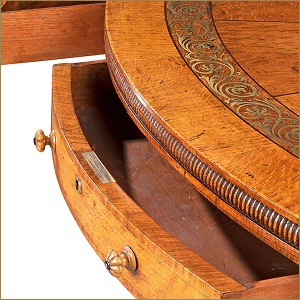
A fine-quality 19th-century centre table, attributed to Collinson & Lock, with a circular top richly inlaid in ebony, amboyna, boxwood and walnut. The dark central field is framed by a striking amboyna band, delicately decorated with scrolling floral sprays, small blossoms and geometric roundels in contrasting woods. Fine lines of stringing define the concentric borders and emphasise the top’s elegant symmetry. The table is raised on a central fluted column and four smaller, similarly fluted supports, all enhanced with inlay and set on a cross-shaped platform. Four boldly out-swept, shaped legs extend from the base, their surfaces ornamented with further foliate marquetry and terminating in scrolling feet. The richly figured veneers, meticulous detailing and architectural support combine to create a confident, decorative piece characteristic of Victorian taste. Its balanced design makes it a handsome focal point for a drawing room or reception interior.
Collinson & Lock was a prominent London cabinet-making and interior-furnishing firm founded in 1870 by Francis Collinson and George Lock, who had previously worked for Jackson & Graham. They took over the established Fleet Street business of Herring & Company, then expanded to premises on Oxford Street.
The firm became known for “art furniture,” combining skilled craftsmanship with historic styles and contemporary design. Its early work drew on English and Renaissance precedents; later pieces often embraced the richly decorated, sometimes French-influenced aesthetic fashionable in the Victorian period. In 1871, the partners published Sketches of Artistic Furniture, promoting their designs. They also worked with notable designers, including E. W. Godwin and Stephen Webb, and supplied furniture and interior fittings for wealthy private clients and public buildings.
Collinson & Lock took over Jackson & Graham in 1885. The business ended in 1897, when it was absorbed into the newly formed Waring & Gillow. A table attributed to the firm reflects its reputation for elaborate marquetry and finely finished “art furniture.” (bifmo.furniturehistorysociety.org)
Batch 90 UDZZE 65811


Selected Artworks
Linke style ormolu desk set
£2800
Large Regency period Specimen marble centre table, circa 1820. 112cm(44")
£75000
Pair of Louis XIV Style Side Tables, C19th
£4200
19th Century Chinoiserie lacquer occasional table.
£4800
Linke style Gueridon, with parquetry inlay and gilded ormolu mounts.
£5800
French parquetry inlaid centre / console table, After Francoise Linke
£10000
Recently viewed
Linke style ormolu desk set
£2800
Large Regency period Specimen marble centre table, circa 1820. 112cm(44")
£75000
Pair of Louis XIV Style Side Tables, C19th
£4200
19th Century Chinoiserie lacquer occasional table.
£4800
Linke style Gueridon, with parquetry inlay and gilded ormolu mounts.
£5800
French parquetry inlaid centre / console table, After Francoise Linke
£10000

Fine C19th marquetry inlaid centre table, attributed to Collinson + Lock

Fine C19th marquetry inlaid centre table, attributed to Collinson + Lock